Securing Autonomous Supply Chains with Blockchain: A 2025 Case Study in EV Battery Production
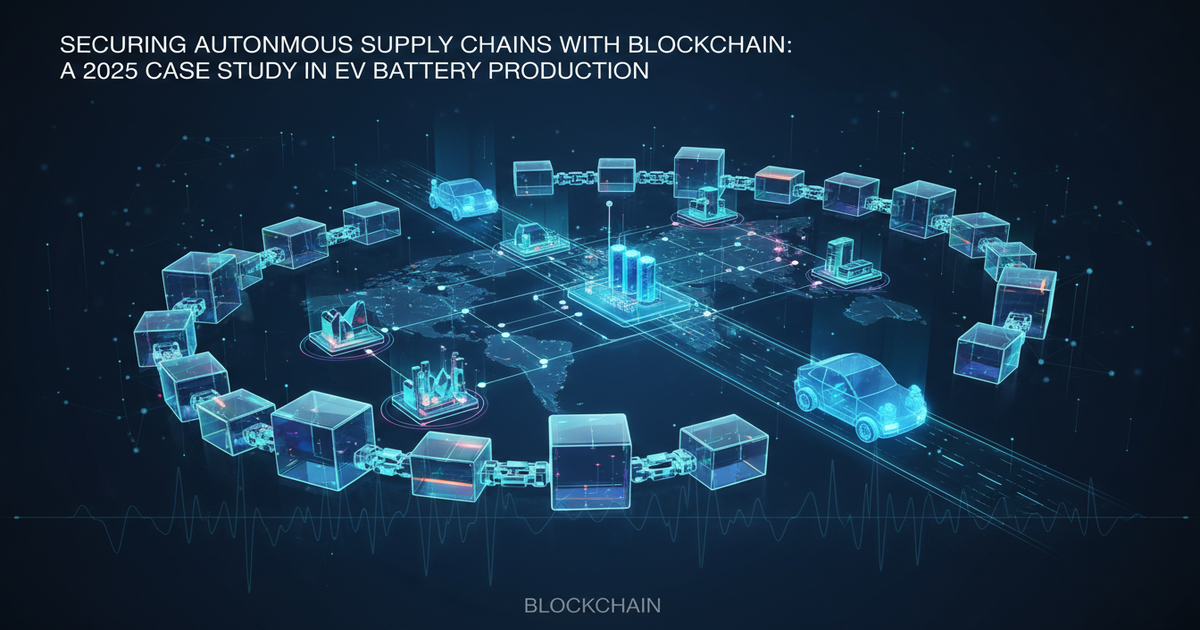
The global supply chain is a complex, intricate web, and by 2025, it’s evolving at an unprecedented pace towards autonomy. For industries like Electric Vehicle (EV) battery production, this shift introduces both immense opportunities and significant vulnerabilities. Imagine a world where critical components like lithium and cobalt are sourced, tracked, and delivered with minimal human intervention. While efficient, this autonomy demands an unshakeable foundation of trust and security. This is precisely where blockchain technology steps in.
Today, you’re navigating a landscape fraught with challenges: ethical sourcing concerns, counterfeiting risks, geopolitical uncertainties, and the relentless pressure for sustainability. Traditional, centralized supply chain management systems simply aren't equipped to handle the scale, speed, and trust requirements of fully autonomous operations. But what if there was a way to imbue every transaction, every movement, and every data point with immutable trust? Let's explore how blockchain is poised to revolutionize the EV battery supply chain by 2025, making it more secure, transparent, and resilient.
The EV Battery Supply Chain Challenge in 2025: A Digital Tightrope Walk
The demand for EVs is skyrocketing, driving an equivalent surge in battery production. This isn't just about manufacturing; it's about a global network of raw material extraction, processing, component manufacturing, assembly, and recycling. By 2025, automation and AI are deeply integrated, pushing towards end-to-end autonomous processes. However, this autonomy amplifies inherent risks.
Consider the journey of a single EV battery. It starts with raw materials often sourced from politically sensitive regions, continues through multiple processing stages across continents, and finally integrates into a high-tech vehicle. Each step is a potential point of failure, fraud, or ethical compromise. You need a system that can verify the origin of materials, ensure fair labor practices, prevent the infiltration of counterfeit components, and provide real-time visibility across the entire lifecycle.
Actionable Takeaway: Centralized databases are single points of failure. Future-proof your supply chain by considering decentralized alternatives that offer enhanced resilience and data integrity.
Blockchain's Immutable Ledger: The Foundation of Trust for Autonomy
Distributed Ledger Technology (DLT), commonly known as blockchain, offers a paradigm shift. Unlike traditional databases, blockchain creates an immutable, transparent, and cryptographically secured record of every transaction. This means once data is recorded, it cannot be altered or deleted, providing an unparalleled level of trust and verifiability.
For autonomous supply chains, this immutability is crucial. Imagine smart contracts — self-executing agreements whose terms are directly written into code. These contracts can automatically trigger payments, order new stock, or even initiate recalls based on predefined conditions met by IoT sensors or other verifiable data inputs. This eliminates manual intervention, reduces human error, and accelerates processes, making true autonomy feasible.
Furthermore, the use of cryptocurrencies or tokenized assets within these blockchain networks can streamline cross-border payments and incentivize compliant behavior among supply chain partners. This creates a robust, self-regulating ecosystem where transparency isn't just a goal, but an inherent feature of the system.
Case Study: "VoltChain" – Securing EV Battery Production in 2025
Let’s envision a leading EV manufacturer, "ElectroMotors," which by 2025 has implemented a blockchain-powered autonomous supply chain called "VoltChain" for its next-generation battery production. This system leverages a private, permissioned blockchain network, ensuring data privacy while maintaining transparency among authorized participants.
Sourcing and Ethical Traceability with Digital Twins
ElectroMotors faced significant challenges in verifying the ethical sourcing of critical minerals like cobalt and nickel. With VoltChain, each batch of raw material is assigned a unique digital identity (a non-fungible token, or NFT) at its origin. Miners use tamper-proof IoT devices to record extraction data, which is then immutably logged on the blockchain.
- Real-time Verification: Supply chain participants, including auditors and regulatory bodies, can instantly verify the provenance of materials, ensuring they meet ethical and environmental standards.
- Automated Compliance: Smart contracts automatically flag any discrepancies in sourcing data, preventing non-compliant materials from entering the production line.
- Enhanced Reputation: ElectroMotors publicly shares anonymized, verifiable data on its sourcing practices, building consumer trust and brand loyalty.
Automated Quality Control and Supply Chain Visibility
As materials move through refining, component manufacturing, and assembly plants, IoT sensors continuously monitor parameters like purity, temperature, and structural integrity. This data is fed directly into the VoltChain blockchain, triggering smart contracts.
// Example Smart Contract Function (Simplified Solidity)
function recordQualityCheck(string materialID, bool passed, string inspectorID) public {
    require(msg.sender == authorizedInspector, "Only authorized inspectors can record quality.");
    // Store quality check result on-chain
    qualityRecords[materialID].push(QualityCheck(passed, inspectorID, block.timestamp));
    if (!passed) {
        emit QualityFailure(materialID, inspectorID, "Material failed quality inspection.");
        // Trigger automated rejection or re-routing
        // Additional logic for dispute resolution or re-inspection
    }
}
If a component fails a quality check, a smart contract automatically alerts relevant stakeholders, initiates a return or rework process, and adjusts inventory levels without human intervention. This significantly reduces lead times and minimizes waste.
Actionable Takeaway: Integrate IoT with blockchain to automate quality control and create a real-time, tamper-proof record of product integrity throughout your supply chain.
Preventing Counterfeiting and Enabling Circularity
Each finished battery module receives a unique blockchain-based identifier. This allows ElectroMotors and its customers to verify authenticity throughout the product's lifespan. If a module is tampered with or replaced with a counterfeit, the blockchain record will reveal the discrepancy.
Furthermore, VoltChain facilitates a truly circular economy. When an EV reaches its end-of-life, the battery's entire lifecycle history – from raw material sourcing to usage patterns – is available on the blockchain. This data helps recycling facilities efficiently process and reclaim valuable materials, optimizing resource recovery and reducing environmental impact.
- Secure Authentication: Consumers can scan a QR code on their battery to verify its origin and authenticity.
- Optimized Recycling: Detailed material composition and usage data enables more efficient and sustainable recycling processes.
Overcoming Implementation Hurdles and Future Outlook
While the benefits are clear, implementing such a robust blockchain solution isn't without its challenges. Interoperability between different blockchain networks and legacy systems remains a hurdle. Scalability solutions, such as Layer 2 networks and sharding, are crucial for handling the massive transaction volumes of a global supply chain.
Regulatory frameworks are still catching up with the rapid pace of DLT innovation. Data privacy concerns, especially with sensitive commercial information, require careful architectural design, often leveraging zero-knowledge proofs or private data layers. However, by 2025, significant progress is being made in these areas.
The future of autonomous supply chains is inextricably linked with blockchain. Expect to see greater adoption of enterprise-grade DLT platforms, increased standardization, and tighter integration with AI and IoT. This synergy will create truly intelligent, self-optimizing supply networks that are not only efficient but also inherently trustworthy and resilient.
Conclusion: Building a Trustworthy Autonomous Future
The journey towards fully autonomous supply chains in 2025 is exciting, but it demands an equally robust framework for security and trust. As we've seen with our "VoltChain" case study, blockchain technology, with its immutable ledgers and self-executing smart contracts, provides that essential foundation. It transforms opaque, vulnerable networks into transparent, verifiable, and highly secure ecosystems.
By embracing blockchain, you can unlock unprecedented levels of efficiency, mitigate risks from ethical sourcing to counterfeiting, and build a truly sustainable future for critical industries like EV battery production. Don't just automate your supply chain; decentralize its trust. The time to invest in a blockchain-powered future is now, ensuring your autonomous operations are not just fast, but fundamentally secure and reliable. Are you ready to lead the charge in this new era of supply chain innovation?