Optimizing AI Workloads: Specialized GPU Clouds vs. Hyperscalers in 2025
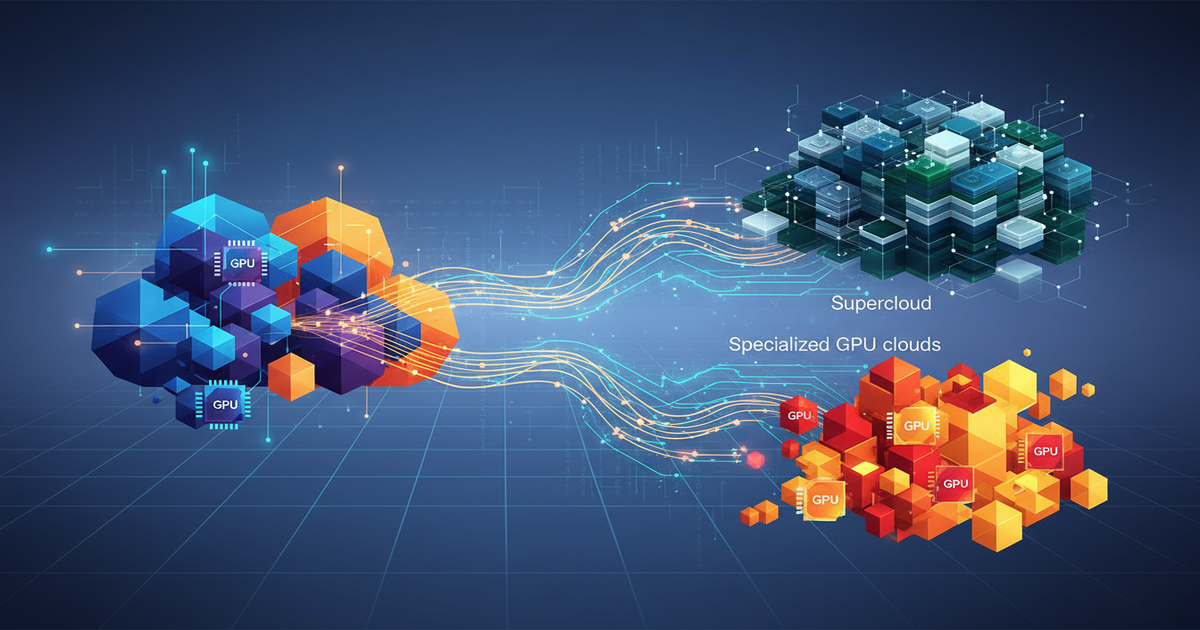
The AI revolution is here, and it's hungry. From powering advanced large language models (LLMs) to driving breakthroughs in scientific research, AI's computational demands are escalating. As we navigate 2025, organizations face a critical decision: where to host these demanding AI workloads? The choice often boils down to established giants – hyperscalers like AWS, Azure, and GCP – or agile, specialized GPU cloud providers. This isn't just about raw compute; it's about cost-efficiency, specialized support, scalability, and strategic alignment for your unique AI journey. Let's compare these options for 2025 to help you make an informed decision.
The AI Workload Evolution in 2025
The AI landscape has transformed dramatically. Training foundational models now requires thousands of top-tier GPUs operating in concert for months. Generative AI and real-time inference demand immense processing power, high-bandwidth interconnects, and optimized software stacks. Your infrastructure needs to be purpose-built for AI.
This evolution brings challenges in cost and access to the latest hardware. NVIDIA's H200 and upcoming B200 GPUs set new benchmarks, but securing large quantities affordably is a hurdle. Understanding each cloud provider's offering is paramount to unlocking peak performance and managing your budget effectively.
Hyperscalers: The Established Giants (AWS, Azure, GCP)
The "big three" – AWS, Azure, and GCP – offer unparalleled breadth and depth of cloud services. They are the go-to for many enterprises due to global reach, robust security, and extensive integrated ecosystems. If your organization already integrates deeply with one, leveraging their AI/ML services often seems natural.
Strengths of Hyperscalers for AI
- Comprehensive Ecosystems: Access to vast services beyond GPUs, including MLOps platforms (SageMaker, Azure ML, Vertex AI), data lakes, and analytics. Seamless integration for your entire AI pipeline.
- Global Footprint & Redundancy: Worldwide data centers, offering low-latency and robust disaster recovery, crucial for global deployments.
- Enterprise-Grade Features: Strong security, compliance (HIPAA, GDPR, SOC 2), identity management, and extensive networking capabilities.
- Financial Flexibility: Reserved instances and savings plans can offer cost savings for predictable workloads.
Weaknesses for Specialized AI Workloads
- Premium GPU Pricing: Cost per GPU-hour for the latest models (H100s, H200s) can be significantly higher, especially for long-running training.
- Resource Contention: Access to cutting-edge GPUs in large quantities can be constrained during peak demand.
- Less Specialized Support: General cloud support is excellent, but deep, AI-specific hardware/software optimization support might be less specialized.
Actionable Takeaway: Choose hyperscalers when your AI workloads are part of a broader cloud strategy, require extensive ancillary services, or demand global distribution and enterprise compliance. Ideal for fine-tuning smaller models, inference at scale, and leveraging managed MLOps platforms.
Specialized GPU Clouds: The Nimble Challengers
A new breed of cloud providers has emerged, purpose-built for AI and machine learning. Companies like CoreWeave, Lambda Labs, and RunPod focus almost exclusively on providing bare-metal or highly optimized virtualized access to the latest NVIDIA GPUs, often at a more competitive price. They are designed for raw compute power and efficiency.
Strengths of Specialized GPU Clouds for AI
- Access to Latest Hardware: Often secure newest NVIDIA GPUs (H100, H200, B200) faster and in larger quantities, ideal for bleeding-edge research and model training.
- Superior Cost-Performance Ratio: Significantly lower prices per GPU-hour, especially for large clusters. Massive savings for intensive model training.
- Optimized Infrastructure: Data centers engineered specifically for HPC, featuring high-bandwidth interconnects (like InfiniBand) crucial for distributed training.
- Specialized Support: Teams are typically experts in GPU computing and ML frameworks, offering highly relevant technical assistance.
Weaknesses for Broad Cloud Strategies
- Limited Ecosystem: Less breadth of integrated services (databases, serverless). You often need to bring your own tools or integrate with other providers.
- Smaller Global Footprint: Fewer data center regions than hyperscalers, potentially impacting latency or data residency.
- Operational Overhead: You might bear more responsibility for managing the software stack and data storage, requiring more in-house DevOps expertise.
Actionable Takeaway: Opt for specialized GPU clouds when your primary need is raw, cost-effective GPU compute for large-scale model training, fine-tuning, or high-throughput inference, especially for the latest hardware. Perfect for AI startups, research labs, and heavy compute budgets.
Key Decision Factors for 2025
Making the right choice is a strategic alignment of your project's needs with the provider's strengths. In 2025, consider these critical factors:
- Cost-Performance Ratio & Total Cost of Ownership (TCO): Evaluate beyond hourly rates. Hyperscalers offer managed services reducing operational overhead, while specialized providers have lower raw GPU costs. Factor in data egress, storage, networking, and engineering time.
- Scalability and Availability: How quickly can you scale to thousands of GPUs? Hyperscalers offer robust availability; specialized providers often boast immediate access to large clusters.
- Ecosystem Integration & MLOps Maturity: Do you need a fully integrated MLOps platform (SageMaker, Azure ML, Vertex AI) or prefer building your own stack on bare-metal access?
- Data Governance and Compliance: For regulated industries, data residency and certifications (FedRAMP, HIPAA) are non-negotiable. Hyperscalers generally have a broader compliance track record.
- Support and Expertise: Do you need general cloud support, or deep expertise in optimizing distributed training on specific GPU architectures? Specialized providers often have more focused AI/ML expert support.
Real-World Scenarios & Hybrid Strategies
Let's see how these choices play out.
Scenario 1: AI Startup Training a Foundational LLM
A startup developing a groundbreaking LLM needs thousands of H200 GPUs for months, with tight budget constraints.
- Choice: A specialized GPU cloud is optimal. Cost savings on raw compute will be immense; direct access to the latest hardware and high-bandwidth interconnects will accelerate training. They can then use a hyperscaler for serving inference APIs and hosting their website.
Scenario 2: Large Enterprise Fine-tuning & Inference
A global enterprise fine-tunes open-source models for business units and deploys them for real-time inference across multiple regions, with strict compliance. They already use a hyperscaler for core IT.
- Choice: Leaning on their existing hyperscaler (AWS, Azure, or GCP) is logical. They leverage managed MLOps for fine-tuning, benefit from global deployment, and integrate seamlessly with existing security and data governance.
The Hybrid Approach: Best of Both Worlds
Many organizations adopt a hybrid strategy:
- Specialized Cloud for Training: Use specialized GPU clouds for compute-intensive, cost-sensitive training.
- Hyperscaler for Ecosystem & Inference: Leverage hyperscalers for managed services, data storage, global deployment of inference endpoints, and integration with broader enterprise applications.
- Data Locality: Store large datasets in a hyperscaler's object storage (S3, Azure Blob, GCS) and use high-speed connections to specialized GPU clouds for training, transferring models back for deployment.
This strategic blending allows you to harness the raw power and cost-efficiency of specialized providers while benefiting from the comprehensive ecosystems and enterprise-grade features of hyperscalers.
Conclusion
The decision between specialized GPU clouds and hyperscalers for your AI workloads in 2025 is nuanced, reflecting your AI initiatives' maturity and overall cloud strategy. There's no one-size-fits-all answer. As AI continues its rapid ascent, understanding the unique advantages and disadvantages of each option becomes critical.
Evaluate your specific needs: Are you a startup needing raw, cost-effective compute for foundational model training? Or an enterprise prioritizing integration, global reach, and compliance? Perhaps a hybrid approach, leveraging the strengths of both, is your optimal path forward. The future of AI is cloud-native, and making an informed infrastructure choice today will significantly impact your innovation velocity and cost efficiency tomorrow.
Ready to optimize your AI infrastructure? Audit your current AI workloads, forecast future compute needs, and run pilot projects on both types of platforms. This hands-on experience will provide invaluable insights to guide your strategic decisions.