Combating 2025's AI-Promoted Malware: Blockchain for Software Supply Chain Integrity
The digital landscape of 2025 presents a formidable challenge: the proliferation of AI-promoted malware. As artificial intelligence advances, so too does its weaponization by malicious actors, leading to sophisticated, adaptive threats that target the very foundation of our digital infrastructure – the software supply chain. Imagine a world where every piece of code you integrate, every library you use, could be a Trojan horse, subtly injected and perfected by AI. This isn't science fiction; it's the near future we must prepare for.
For developers, enterprises, and end-users alike, the integrity of the software supply chain has become paramount. Traditional security measures, while still vital, are struggling to keep pace with the dynamic nature of AI-driven attacks. This is where blockchain technology, with its inherent properties of immutability, transparency, and decentralization, emerges as a powerful, perhaps indispensable, tool in our defensive arsenal. You have the opportunity to build a more resilient future, and it starts with understanding how.
The Evolving Threat Landscape: AI-Powered Malware in 2025
By 2025, AI-driven malware will be a significant force, moving beyond simple automation to exhibit semi-autonomous decision-making capabilities. These threats won't just exploit vulnerabilities; they will actively seek them out, adapt their attack vectors in real-time, and leverage deepfake technology to bypass human verification. Think of polymorphic malware that constantly reshapes its code to evade detection, or sophisticated phishing campaigns crafted by generative AI that are virtually indistinguishable from legitimate communications.
Supply chain attacks, like the infamous SolarWinds incident, demonstrated the devastating impact of compromising a trusted vendor. In 2025, AI will supercharge these attacks, making them harder to detect and even more pervasive. Attackers can use AI to identify critical components, craft highly targeted injections, and even automate the exfiltration of sensitive data, all while blending seamlessly into legitimate traffic patterns. Your vigilance alone won't be enough; you need systemic, verifiable security.
Actionable Takeaway: Assume compromise at every layer. Implement a zero-trust mindset, verifying every component and interaction, regardless of origin. Recognize that human review is increasingly fallible against AI-generated deception.
Blockchain as a Foundation for Unshakeable Trust
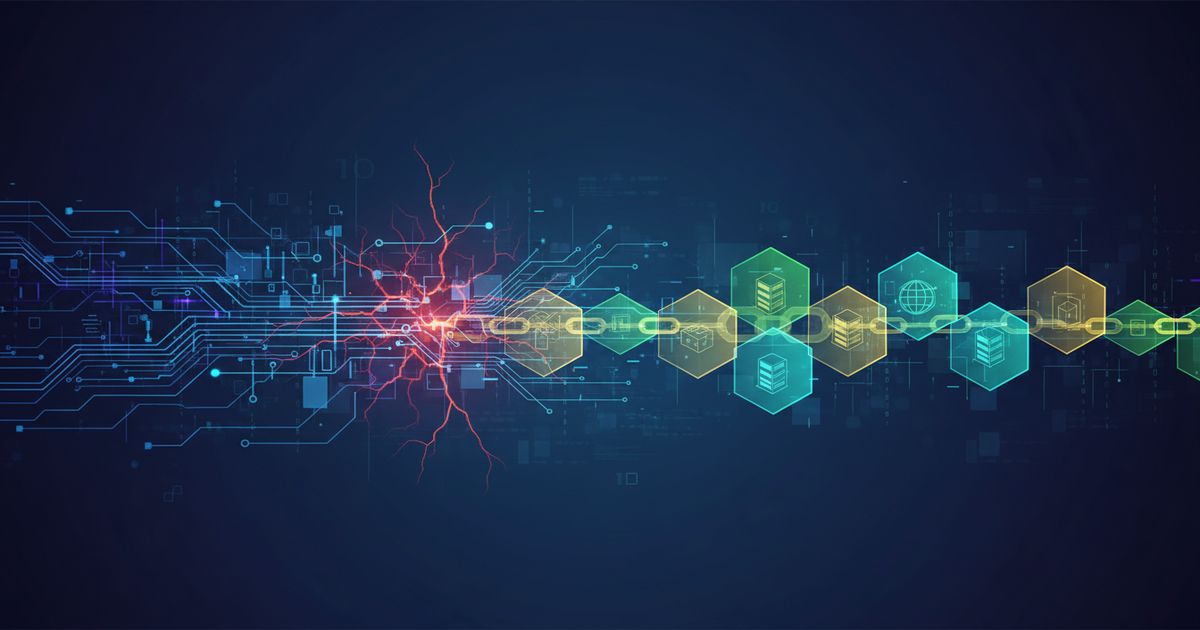
At its core, blockchain is a distributed, immutable ledger. Every transaction, every piece of data recorded, is cryptographically linked to the previous one, forming a chain that is incredibly difficult to alter. This inherent immutability is the bedrock upon which a secure software supply chain can be built. You can create an undeniable, transparent record of every step a software component takes, from its initial commit to its final deployment.
Imagine a scenario where every version control commit, every build artifact, and every dependency scan result is hashed and recorded on a public or consortium blockchain. This creates an unalterable audit trail. Any tampering, no matter how subtle, would break the cryptographic link, immediately signaling a potential compromise. This level of transparency offers an unprecedented layer of security that traditional databases simply cannot match.
- Immutability: Once data is recorded, it cannot be changed, ensuring the integrity of the supply chain history.
- Transparency: All authorized parties can view the ledger, fostering trust and accountability.
- Decentralization: No single point of failure; the network is maintained by multiple participants, making it resilient to attack.
- Cryptographic Proofs: Each entry is secured with advanced cryptography, verifying its authenticity and origin.
Smart Contracts for Automated Integrity and Policy Enforcement
Smart contracts are self-executing contracts with the terms of the agreement directly written into code. Deployed on a blockchain, they execute automatically when predefined conditions are met, without the need for intermediaries. This automation is a game-changer for software supply chain integrity, allowing you to enforce security policies with unparalleled consistency and speed.
Consider a smart contract designed to validate software components. Before a new version of a library can be incorporated into a build, the smart contract could automatically check several conditions: has the code been reviewed by at least two senior developers (recorded via decentralized identity)? Does its cryptographic hash match the one committed by the original author? Has it passed all security scans, with results also recorded on-chain? If any condition fails, the contract prevents further progression, effectively halting a potential AI-promoted malware injection.
// Conceptual Solidity Smart Contract Snippet
pragma solidity ^0.8.0;

contract SoftwareSupplyChainMonitor {
    struct Component {
        bytes32 componentHash;
        string name;
        uint256 timestamp;
        address developer;
        bool isVerified;
    }

    mapping(bytes32 => Component) public components;

    event ComponentAdded(bytes32 indexed componentHash, string name, address developer);
    event ComponentVerified(bytes32 indexed componentHash, address verifier);

    function addComponent(bytes32 _componentHash, string memory _name) public {
        require(components[_componentHash].timestamp == 0, "Component already exists");
        components[_componentHash] = Component({
            componentHash: _componentHash,
            name: _name,
            timestamp: block.timestamp,
            developer: msg.sender,
            isVerified: false
        });
        emit ComponentAdded(_componentHash, _name, msg.sender);
    }

    function verifyComponent(bytes32 _componentHash) public {
        require(components[_componentHash].timestamp != 0, "Component does not exist");
        require(!components[_componentHash].isVerified, "Component already verified");
        // Additional verification logic could go here, e.g., requiring multiple sign-offs
        components[_componentHash].isVerified = true;
        emit ComponentVerified(_componentHash, msg.sender);
    }
}
This basic example illustrates how you could record and verify components. More complex contracts could integrate with CI/CD pipelines, trigger alerts, or even initiate automated rollbacks if a compromised component is detected. The power lies in the deterministic, tamper-proof execution of your security policies.
Decentralized Identity and Cryptographic Attestation
Verifying who is doing what is just as critical as verifying the what itself. Decentralized Identity (DID) systems, often built on blockchain, empower individuals and entities to control their own digital identities, independent of centralized authorities. This is crucial for securing the software supply chain against sophisticated social engineering and identity spoofing tactics often employed by AI-driven attacks.
With DIDs, every developer, every auditor, every build server can have a verifiable identity recorded on the blockchain. Cryptographic attestations then provide verifiable proofs of specific actions or claims. For instance, a developer could cryptographically attest that they authored a specific code commit, or a security scanner could attest that it found zero critical vulnerabilities in a particular artifact. These attestations are immutable and publicly verifiable, making it incredibly difficult for AI-promoted malware to impersonate legitimate actors or falsify security reports.
Actionable Takeaway: Explore DID solutions like ION (built on Bitcoin) or Ethereum-based identity systems. Integrate these into your developer workflows to ensure every action in the supply chain is tied to a verifiable, decentralized identity. Implement multi-factor authentication (MFA) that leverages decentralized credentials.
Implementing a Blockchain-Secured Software Supply Chain
Adopting blockchain for supply chain integrity isn't an overnight task, but it's a strategic imperative for 2025. Here are key steps you can take:
- Identify Critical Components: Map your software supply chain to pinpoint the most vulnerable and critical components and processes. Start with these high-risk areas.
- Choose a Blockchain Platform: Evaluate public blockchains (Ethereum, Polygon, Avalanche) or private/consortium chains (Hyperledger Fabric, Corda) based on your needs for decentralization, transaction speed, cost, and privacy. For public attestation, public chains offer greater trust.
- Integrate with CI/CD: Develop connectors to automatically hash and record key events (code commits, build completions, dependency updates, test results) onto the chosen blockchain. This ensures continuous monitoring.
- Develop Smart Contracts: Design smart contracts to define and enforce your security policies. This includes component verification, identity checks, and automated response mechanisms.
- Embrace Decentralized Identity: Implement DID solutions for all human and machine actors involved in the supply chain. This ensures verifiable accountability.
- Regular Audits and Monitoring: While blockchain is immutable, your implementation still requires regular security audits. Monitor the blockchain for anomalies or failed attestations.
Challenges include managing transaction costs (gas fees), scalability, and the initial complexity of integrating blockchain into existing systems. However, the long-term benefits of enhanced security and trust far outweigh these hurdles. The cost of a major supply chain breach, especially one orchestrated by AI, can be catastrophic, making these investments a necessity.
Conclusion: Building a Resilient Digital Future
The threat of AI-promoted malware in 2025 is real and growing. It demands a paradigm shift in how we approach software supply chain security. Blockchain technology, with its unique blend of immutability, transparency, and the power of smart contracts and decentralized identity, offers a robust framework to combat these evolving threats. By embracing these innovative solutions, you can move beyond reactive defense to proactive, verifiable integrity.
It’s time to fortify your digital foundations. Don't wait for the next major breach to act. Start exploring how blockchain can secure your software supply chain today, making your systems resilient against the AI-powered threats of tomorrow. Your proactive steps now will safeguard your projects, your users, and the entire digital ecosystem.
Comments
Join the discussionNo comments yet. Be the first to comment.